Why Are My Teeth Sensitive to Cold? A Practical Guide to Tooth Sensitivity

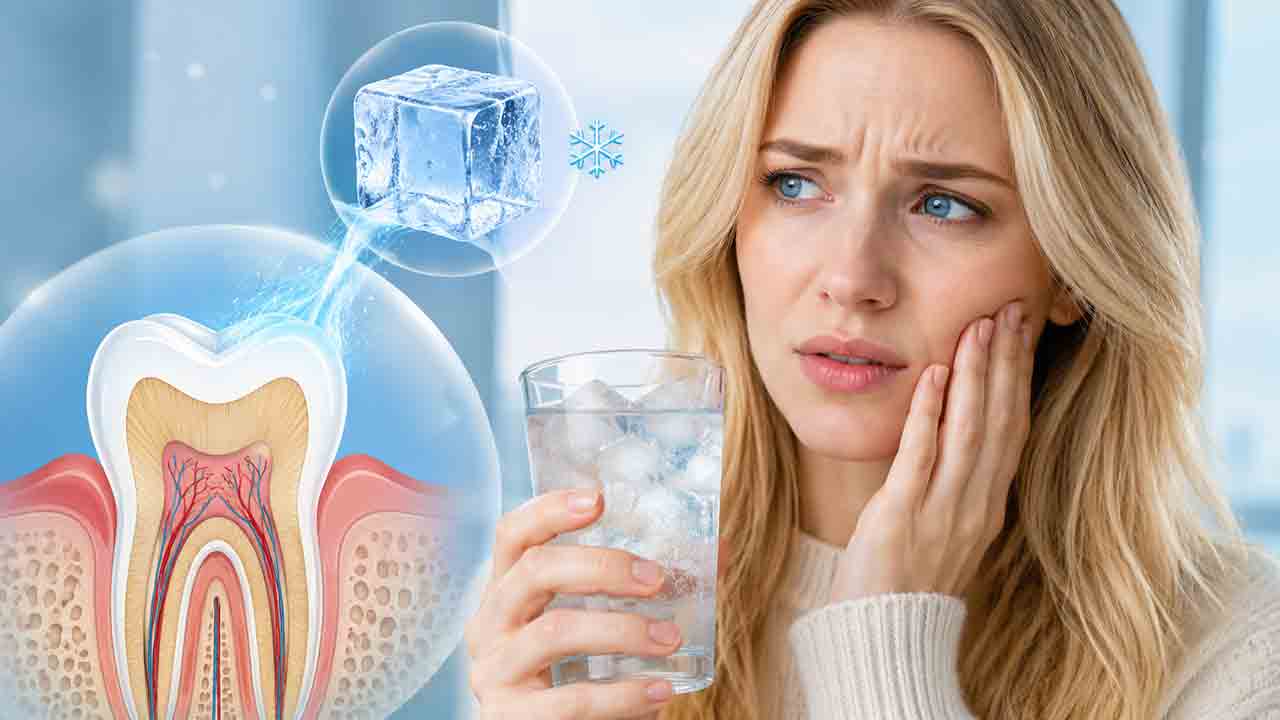
Taking a sip of ice water should be an ordinary moment.When one tooth answers with a sudden electric jolt, however, the experience can be surprisingly specific. You may know exactly which tooth reacted, where the sensation started, and how quickly it disappeared.
Those details are useful because “tooth sensitivity” describes a symptom, not a single dental condition.
A brief reaction to cold can have a different context from pain that continues after the drink is gone. Sensitivity affecting several teeth can raise different questions from a sharp sensation isolated to one tooth. Pain that appears mainly while chewing may also lead a dentist to investigate a different set of possibilities.
According to the American Dental Association (ADA), possible causes of sensitive teeth include tooth decay, fractured teeth, worn fillings, gum disease, worn tooth enamel, and exposed tooth roots. The appropriate treatment depends on what is causing the sensitivity.
So instead of asking only:
“Why are my teeth sensitive?”
it is often more useful to describe exactly which tooth reacts, what triggers it, how long the sensation lasts, and whether anything else has changed.
That information gives a dentist a much better starting point.
Why Cold Can Reach a Sensitive Part of a Tooth
The visible crown of a healthy tooth is protected by enamel. Below the gumline, cementum helps cover the root.
Under those protective layers is dentin.
Dentin contains microscopic tubules. The ADA explains that when dentin loses some of its protective enamel or cementum covering, temperature, acidic foods, sticky foods, and other stimuli can travel through these tubules toward the nerves and cells inside the tooth. Receding gums can also expose dentin on root surfaces.
That helps explain why some forms of sensitivity feel sharp and immediate.
But exposed dentin is only one possibility.
Decay, a fracture, a worn restoration, gum recession, or another dental condition can create overlapping symptoms. This is why the sensation itself cannot tell you exactly what is happening inside the tooth.
One Sensitive Tooth Tells a Different Story From Several
One of the most useful observations is simply how many teeth are involved.
If several teeth become sensitive around the same time, a dentist may ask about broader changes such as:
- recent whitening;
- changes in oral-care products;
- exposed root surfaces;
- changes around the gumline;
- dietary habits;
- recent dental procedures.
When one specific tooth reacts repeatedly, the investigation may become more localized.
A dentist may look for evidence of:
- tooth decay;
- an existing filling or restoration;
- structural damage;
- an exposed root surface;
- changes at the gumline;
- previous dental trauma;
- bite-related problems;
- irritation involving the tissues inside the tooth.
None of those possibilities can be confirmed reliably by looking at the tooth in a mirror.
Localization simply helps narrow the clinical question.
Keep a Tooth Sensitivity Trigger Tracker
Memory becomes surprisingly vague once you are sitting in a dental chair.
A short record of naturally occurring symptoms can make the conversation much more precise.
Do not intentionally test a painful tooth with ice, extremely hot food, hard objects, or repeated biting. Just record what happens during ordinary eating and drinking.
After a few days, you may be able to give the dentist a description such as:
“One upper-right back tooth reacts sharply to cold drinks. The sensation stops soon after the cold is gone, and I have not noticed pain while chewing.”
That is much more informative than simply saying:
“My teeth are sensitive.”
The tracker is intended to organize observations for a dental visit. It is not a scoring system and should not be used to identify the cause on your own.
The Duration of Sensitivity Is Worth Mentioning
Dentists often ask what happens after the trigger disappears.
A sensation that ends almost immediately presents a different history from discomfort that continues well after the cold drink, hot food, or other stimulus has been removed.
The American Association of Endodontists (AAE) also distinguishes among different patterns of tooth pain, including momentary temperature sensitivity, pain with biting, and more persistent responses to hot or cold. These patterns can provide useful diagnostic clues, but they are not standalone diagnoses.
Rather than trying to label the condition yourself, describe the timing:
- stops immediately;
- fades within several seconds;
- continues noticeably afterward;
- changes into a dull ache;
- appears without a clear trigger.
A dentist can interpret that information alongside examination findings and, when appropriate, other diagnostic tests.
Cold Sensitivity and Biting Pain Should Be Described Separately
Suppose cold water causes a quick sharp sensation.
Now suppose the same tooth also hurts while chewing something firm.
Those are two observations, not one.
The AAE notes that cracked teeth can sometimes cause irregular pain while chewing as well as sensitivity to temperature. Symptoms can vary considerably, and some cracks may be difficult to locate.
That does not mean biting pain confirms a cracked tooth.Decay, restoration problems, periodontal conditions, trauma, and other dental problems may also need consideration.
If chewing causes discomfort, tell the dentist specifically.
Avoid repeatedly biting down on hard objects to see whether you can reproduce the sensation. Provoking the symptom at home is unlikely to answer the diagnostic question and may further irritate the tooth.
A Tooth Can Have Decay Before It Hurts
Pain is a poor screening system for cavities.
The National Institute of Dental and Craniofacial Research (NIDCR) explains that early tooth decay usually has no symptoms. As decay progresses, a person may develop toothache or sensitivity to sweets, hot foods, or cold foods.
That means two common assumptions are unreliable:
“It only hurts when something cold touches it, so it cannot be decay.”
and:
“It doesn't hurt, so there cannot be a cavity.”
Neither conclusion follows from symptoms alone.
A dentist may combine direct examination with dental imaging when clinically indicated to determine whether decay is present and how much tooth structure is affected.
Sensitivity is useful evidence, but it is only one part of the evaluation.
Tell the Dentist About Existing Fillings and Other Dental Work
A sensitive tooth with a restoration deserves context.
If the tooth contains a filling, crown, veneer, inlay, onlay, or other dental work, include that information when describing the problem.
The ADA specifically lists worn fillings among the possible causes associated with sensitive teeth.
That does not mean every sensitive restored tooth has a failing filling.
A dentist may need to consider several questions:
- How old is the restoration?
- Does it still appear intact?
- Is there decay near it?
- Is another part of the tooth damaged?
- Does the bite place unusual pressure on the area?
- Could the symptom actually be coming from a neighboring tooth?
Pain is not always perfectly localized, particularly in the back of the mouth.
That is another reason a dental examination provides information that home observation cannot.
Sensitivity Along the Gumline May Involve Exposed Dentin
The crown of a tooth and its root do not have identical protective coverings.
When gum tissue recedes, a portion of the root surface can become exposed. The ADA explains that this can expose dentin and contribute to hypersensitivity.
If a cold sensation seems strongest near the gumline rather than on the chewing surface, mention that location.
It can be useful information.
Avoid concluding that gum recession must have been caused by one specific brushing habit. Gum position can be influenced by several factors, and the appropriate explanation depends on the individual mouth.
Cracked Teeth Do Not Always Look Cracked
The phrase “cracked tooth” creates an obvious mental picture: a visible line running through the tooth.
Real cracks can be much less straightforward.
The AAE explains that cracked teeth can produce symptoms ranging from intermittent chewing pain to sudden temperature sensitivity, and the responsible tooth may sometimes be difficult to identify.
A normal-looking surface in a mirror therefore does not exclude a structural problem.
Details worth mentioning include whether the tooth:
- became sensitive after biting something unusually hard;
- hurts during normal chewing;
- reacts as biting pressure is released;
- has a large restoration;
- has previously been injured;
- produces symptoms only occasionally.
Those observations help direct a professional examination without turning them into a self-diagnosis.
Sensitivity After Dental Treatment Needs a Timeline
Teeth can sometimes feel different after dental treatment.Whether that deserves immediate concern depends on the procedure, symptom pattern, and how the tooth changes afterward.
Useful details include:
- what treatment was performed;
- when it was completed;
- when sensitivity started;
- whether symptoms are becoming milder or stronger;
- whether the bite feels different;
- whether discomfort happens only with a trigger;
- whether pain begins spontaneously;
- whether swelling has appeared.
A recently treated tooth that is steadily becoming more comfortable presents a different history from one whose symptoms are progressively worsening.
If symptoms are concerning or changing rather than improving, contacting the treating dental office is more useful than trying to determine the cause from generic internet advice.
Where Desensitizing Toothpaste Fits
Desensitizing toothpaste can be useful for certain forms of tooth sensitivity.
According to the ADA, these toothpastes may contain compounds that help reduce transmission of sensation from the tooth surface toward the nerve, and repeated use may be needed before sensitivity decreases.
The limitation is important:
a desensitizing toothpaste addresses certain types of sensitivity; it does not identify why a tooth is sensitive.
It does not repair a fractured tooth or replace missing tooth structure.
It also does not substitute for professional evaluation when symptoms are persistent, strongly localized, worsening, or otherwise concerning.
If one tooth continues to produce symptoms despite ordinary sensitivity care, the next useful step may be determining why that particular tooth behaves differently.
Treatment Depends on the Cause
There is no universal “sensitive tooth treatment.”
The ADA lists several approaches a dentist may consider depending on the underlying problem, including desensitizing toothpaste, fluoride treatment, bonding or restorations, treatment for exposed root surfaces, and—in selected severe situations—root canal treatment.
Those options are not stages that every patient moves through.
They address different clinical situations.
For example, treatment for exposed dentin may look very different from treatment for significant decay or a tooth with deeper pulpal disease.
This is why a responsible treatment discussion starts with diagnosis rather than with the name of a procedure.
Before Asking “Do I Need a Root Canal?”, Ask This Instead
Cold sensitivity often sends people directly to online searches about root canal treatment.
That jump can create unnecessary anxiety.
A more informative question for the dentist is:
“What do you think is causing this tooth to react, and what findings support that explanation?”
If the cause appears to be exposed dentin, the treatment conversation can be very different from the one for a tooth with more significant internal disease.
Root canal treatment is one potential treatment for specific diagnoses. It is not the automatic destination for every sensitive tooth.
Dental X-Rays May Answer Some Questions, Not Every Question
A dentist can see and test many things directly, but some tooth surfaces and internal structures cannot be evaluated visually.
NIDCR notes that dental X-rays can help dentists detect decay that may not otherwise be visible during routine examination.
Depending on the situation, imaging may also provide information about roots, previous dental work, surrounding structures, or other suspected problems.
Still, the image is only part of the evaluation.
An X-ray does not tell the dentist how long cold pain lasts, whether biting causes discomfort, or how a tooth reacts during clinical testing.
The imaging choice should therefore follow the clinical question rather than replace it.
Five Questions That Make a Sensitivity Appointment More Useful
You do not need to know dental terminology to have an informed conversation.
These five questions are usually more useful than asking whether your teeth are simply “good” or “bad”:
- Which tooth do you think is causing the symptom?
- What finding best explains the sensitivity?
- Do you see exposed dentin, decay, structural damage, or a restoration problem?
- Would an X-ray or another test answer an important question?
- What change should make me contact the office again?
The answers help connect symptoms, evidence, and treatment.
When Sensitivity Deserves Professional Attention
Occasional mild sensitivity and persistent tooth pain are not the same experience.
Consider arranging a dental evaluation when sensitivity:
- continues without a clear explanation;
- becomes progressively stronger;
- repeatedly affects one specific tooth;
- interferes with normal eating or drinking;
- occurs along with biting pain;
- appears after trauma;
- accompanies visible tooth damage;
- develops around an existing restoration.
More prompt evaluation may be appropriate when significant swelling, fever, or rapidly worsening dental pain is present. NIDCR notes that untreated decay can progress to infection and may be associated with pain, facial swelling, and fever.
An online article cannot determine the urgency of an individual case, so concerning or rapidly changing symptoms should be assessed professionally.
A Few Common Mistakes Worth Avoiding
Assuming Every Cold-Sensitive Tooth Has Worn Enamel
Sensitivity has several possible causes, including decay, fractures, worn fillings, exposed roots, and enamel loss.
Repeatedly Testing the Tooth
Ice, hard chewing, tapping, or other repeated home tests rarely clarify the diagnosis and can make an irritated tooth more uncomfortable.
Ignoring a Symptom Because Only One Tooth Is Affected
Localization can actually be useful clinical information.
Assuming No Constant Pain Means There Is No Dental Problem
NIDCR notes that early decay commonly has no symptoms.
Starting Cosmetic Treatment Before Understanding a New Symptom
Whitening can itself be associated with temporary sensitivity in some people, so unexplained single-tooth sensitivity deserves clarification before being treated as a purely cosmetic issue.
A Quick Sensitivity Profile to Bring With You
Before your visit, write down:
- Teeth involved: one / several / unsure
- Main trigger: cold / heat / sweet / touch / biting / no obvious trigger
- Duration: immediate / brief / lingering / continuous
- Main location: crown / gumline / difficult to localize
- Existing dental work: none / filling / crown / other
- Recent trauma: yes / no / unsure
- Pain while biting: yes / no
- Visible damage: yes / no / unsure
- Swelling: yes / no
- Trend: improving / unchanged / worsening
There is no score to calculate.
The purpose is simply to give your dentist a clearer history.
What to Remember
Cold sensitivity does not identify one dental disease.
It may occur when dentin becomes exposed, but the ADA also lists cavities, fractured teeth, worn fillings, gum disease, worn enamel, and exposed roots among possible causes.
The most useful information often comes from ordinary observations:
Which tooth reacts?
What triggers it?
How long does it last?
Does chewing cause discomfort?
Is it changing over time?
Those details help move the conversation away from guessing and toward the question that actually matters:
What is making this tooth sensitive, and does the underlying cause need treatment?
Authoritative Sources
- American Dental Association — Sensitive Teeth
- National Institute of Dental and Craniofacial Research — Tooth Decay
- American Association of Endodontists — Cracked Teeth
- American Association of Endodontists — Tooth Pain
About the Author
Skylar Sun writes consumer-focused dental health explainers designed to make everyday dental topics easier to understand.
Skylar's research approach relies on publicly available guidance from established professional and government health organizations, including the American Dental Association (ADA), the National Institute of Dental and Craniofacial Research (NIDCR), and other authoritative dental-health sources relevant to each topic.
Articles are developed with an emphasis on source transparency, careful interpretation of health information, practical reader questions, and clear distinctions between general education and individualized dental care.